







⏱ Estimated reading time: 3 min read
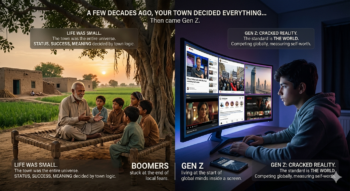
A few decades ago, life was small. A person was born in a town. Died there. Movement was rare. You moved only if you were rich. Enslaved. Or tied to religion or power. For everyone else, home wasn’t just a place. It was the entire universe.
That town decided everything. Beauty. Status. Success. Meaning. A compared himself to the boys next door. If most people had brown skin and you were slightly fair, you were considered beautiful. If everyone had rough hair and yours was softer, you stood out. Maybe Yousaf Khan was the most handsome man in his village. Outside that, he was just a normal man. Maybe Maimoona was only beautiful in Bajaur, but for Bajaur, she was the standard. Maybe Laila was dark-skinned, but in a world without white beauty standards flooding screens, she was simply beautiful.
The same logic applies to wealth, faith, and belief. If someone earned 1,000 a month and you earned 800, you were still rich. And because there was nothing else to compare with, contentment was possible. Happiness was always there. That was the boomer world, whether we romanticize it or not.
Then came Gen Z. And with them, a cracked reality.
Today, a boy sitting in the mountains of northern Pakistan, where electricity disappears for hours, isn’t just living his life. He’s silently competing with a boy in Silicon Valley. Even if not competing, he’s measuring himself against himself. His worth. His future. His chances. Even if he’s the most handsome guy in the village, living in the biggest house, son of the richest man around, something feels off.
Why?
Because the village is no longer the standard.
The standard is Europe. Dubai. New York. Mexico. Bollywood. Instagram. Netflix. YouTube. A Gen Z kid doesn’t grow up comparing himself to neighbors. He grows up comparing himself to the world. And the world is ruthless.
With one swipe, Gen Z can see how others live. How they protest. How they earn. How they love. How they dress. How they question power. A person born a hundred years ago couldn’t leave his city. A Gen Z kid can mentally live everywhere and feel trapped nowhere.
This is why Gen Z wants to change everything. Not because they are rebellious by default, but because comparison breeds questions. If a European can demand a sustainable life, why can’t I? If a man in California can question authority, why can’t I? If a girl in rural Canada can go to school without debate, why can’t a girl here?
And this is where the clash begins.
Boomers see disobedience.
Gen Z sees injustice.
Boomers call it tradition.
Gen Z calls it stagnation.
Boomers are stuck at the end of an era where the town was the world. Gen Z is living at the start of an era where the world lives inside a screen. You cannot raise global minds with local fears. You cannot expose people to the entire planet and expect them to accept a cage politely.
Gen Z isn’t confused. Yet they are so confused.
They are overstimulated, over-aware, and under-empowered.
They don’t want everything to change. Yet want everything to change.
They want explanations that make sense in a world they can already see. But they hardly understand anything.
Every era thought it was the final one. They were wrong. So are we.